What to Put on Sliding Glass Doors for Your Home


What to put on sliding glass doors depends on 3 goals: privacy, light control and style. Panel track blinds, vertical blinds, cellular shades, roller shades and curtains each handle those goals differently. Wide fabric panels and honeycomb shades suit large panes, while vertical blinds cost less and clean easily. How the door is used every day narrows the choice further.
Key Takeaways
- Panel track blinds, vertical blinds, cellular shades, roller shades and curtains are the 5 main coverings for sliding doors.
- Privacy comes from fabric weight and opacity, so sheer and blackout materials give very different results.
- Cellular shades and lined curtains add insulation, while solar shades cut glare and keep the view.
- Cordless designs remove the loose cords that put young children at risk.
- Coverings add comfort and privacy, but impact sliding doors are what add storm protection.
What to Put on Sliding Glass Doors
What to put on sliding glass doors is a covering that meets your privacy, sun and style goals. Five options cover nearly every home. They are panel track blinds, vertical blinds, cellular shades, roller or solar shades, and curtains or drapes.
Each option works with a different door routine. A door used all day needs a covering that moves aside quickly, while a rarely used door can take a heavier treatment. Many homeowners start by looking at custom window blinds because they are measured to fit the full width of the glass.
Sliding doors are wide, so the covering has to be wide too. That size shapes every choice below, starting with the types themselves.
What Is the Right Window Covering for Sliding Doors
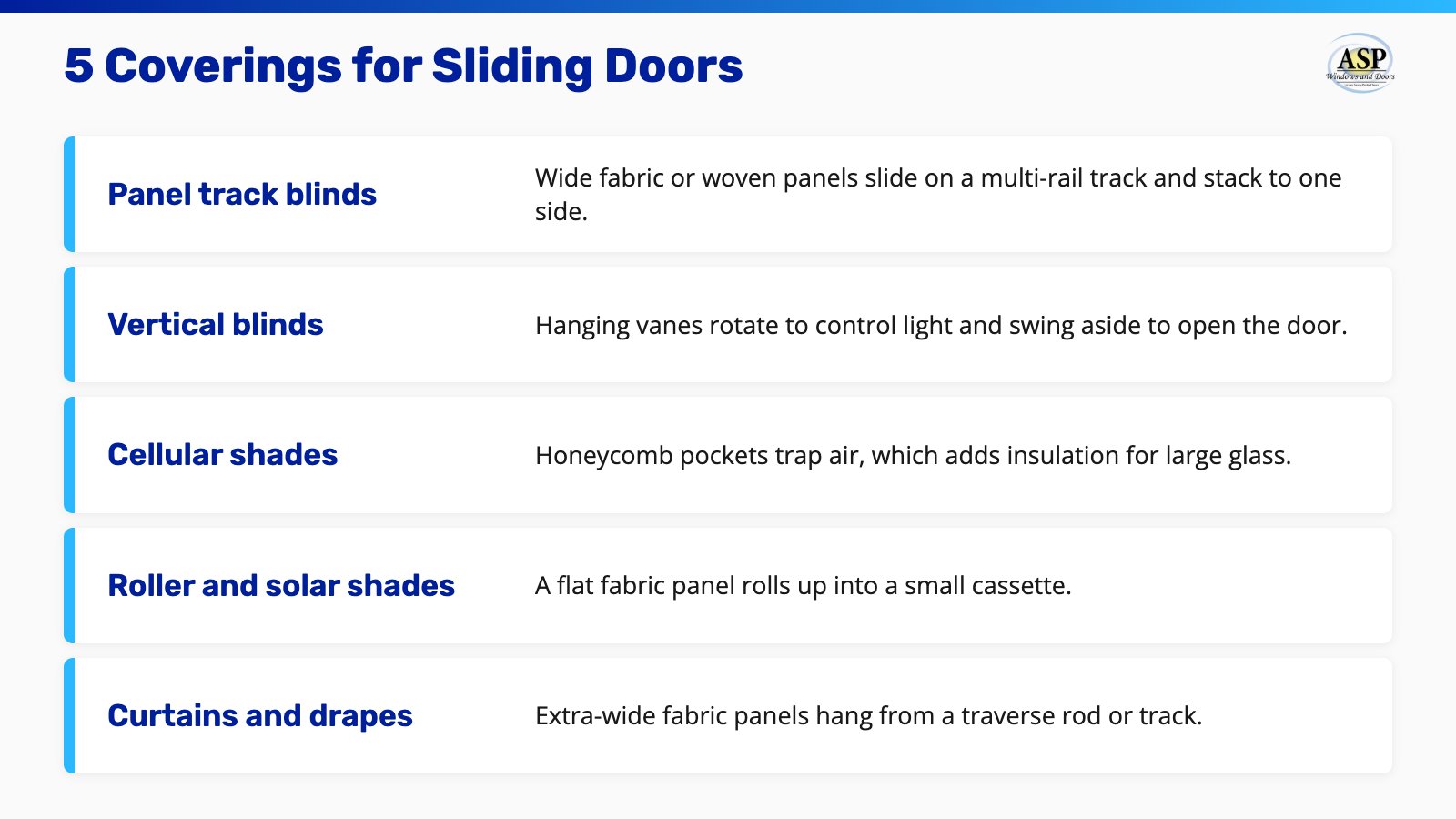
The right window covering for sliding doors is one that opens wide, stacks neatly and matches how you use the door. Five types fit that description. The list below shows how each one works.
- Panel track blinds: Wide fabric or woven panels slide on a multi-rail track and stack to one side. They give a clean, modern look.
- Vertical blinds: Hanging vanes rotate to control light and swing aside to open the door. Updated fabrics and textured vanes look far better than older styles.
- Cellular shades: Honeycomb pockets trap air, which adds insulation for large glass. Vertical versions stack to the side.
- Roller and solar shades: A flat fabric panel rolls up into a small cassette. Solar fabrics cut glare while keeping the outdoor view.
- Curtains and drapes: Extra-wide fabric panels hang from a traverse rod or track. They soften the room and clear the opening when drawn.
Weight and stacking space differ between these types. Privacy is the next factor, because the same glass can feel open or fully closed.
What Can I Put on Sliding Glass Doors for Privacy
What to put on sliding glass doors for privacy is an opaque covering, such as vertical blinds, panel blinds or lined curtains. Each one blocks views from the yard or street at night. Sheer fabrics only blur the view by day.
Privacy levels run from light to full:
- Sheer vertical drapery diffuses light and gives daytime privacy.
- Light-filtering panel track blinds soften the view but stay bright.
- Vertical blinds with closed vanes block nearly all of the view while letting some light through.
- Blackout curtains or room-darkening shades block views and light at night.
Many homeowners combine 2 layers, such as a sheer panel for the day and a heavier fabric for the evening. Privacy and sun control go together, so heat is the next topic.
What Can I Put on My Sliding Glass Doors to Block the Sun
What to put on your sliding glass doors to block the sun is a solar shade, cellular shade or lined curtain. Large glass panes let in strong afternoon light, and that light raises indoor temperatures. A covering on the room side of the glass cuts glare and reduces how much heat reaches the room.
Solar shades use a tight weave that blocks part of the light but keeps the outside view. Cellular shades add an insulating air layer. Thermal-lined drapery works in a similar way.
Lighter, reflective colors facing the glass send more sun back out.
Our guide to heat gain solutions explains other ways to lower solar heat in a South Florida home. A tinted glass layer is one more route.
Our post on window tinting covers what to check first.
Fabric is only one part of the choice. Curtains raise their own questions, which come next.
Should You Put Curtains Over Sliding Doors
Yes, you should put curtains over sliding doors when you want softness, privacy and extra-wide coverage. Curtains hang from a rod or track above the frame and slide open with the door. They also add color and texture to a room that has mostly glass.
Rod placement makes a large difference. Hang the rod 4 to 6 inches above the frame and extend it about 12 inches past each side. The panels then clear the glass completely when open, so the doorway stays wide.
Curtains need floor space and a clear path. Our tips to keep cool show why lined fabric helps. Pets, furniture and wind from an open door can pull on fabric near the track. Homeowners who want less fabric in the way sometimes prefer a different style, which brings up the next question.
What Can I Use Instead of Vertical Blinds on a Sliding Glass Door
Panel track blinds, vertical cellular shades and sheer vertical drapery can replace vertical blinds on a sliding glass door. Many people are replacing vertical blinds because the vanes can clatter, bend or tangle. These alternatives keep the same side-stacking idea with cleaner lines.
Panel track blinds are the closest swap. They use the same overhead track, but wide fabric panels replace the narrow vanes. The same options work instead of blinds for sliding doors, since curtains and cellular shades use no slats at all.
Here is how the replacements compare:
- Panel track blinds give a sleek, modern look with few gaps.
- Vertical cellular shades add insulation and quiet the room.
- Vertical sheers keep a soft look and rotate for light control.
- Curtains replace slats with fabric and need the widest wall space.
Budget matters as much as style for many households. The next section covers lower-cost ways to cover the glass.
What Are Cheap Ways to Cover Sliding Glass Doors
Cheap ways to cover sliding glass doors include standard vertical blinds, tension-rod curtains, stock roller shades and adhesive window film. These options cost less up front than made-to-measure products. They also fit fewer door sizes, so measure carefully before buying.
Several do-it-yourself ideas work for a short time. A hanging curtain panel on a simple rod gives quick privacy. A frosted film on the lower half of the glass adds privacy while keeping the top clear for light.
Lower-cost products have trade-offs. Stock sizes may leave gaps at the edges, and thin materials let more sun through. Ask the door manufacturer or installer before applying film to the glass, because some products are not meant for every glass type. Made-to-measure coverings last longer, so many homeowners compare both paths before deciding.
A measured product only works when the details are right, so the steps below show how to pick one.
How Do You Choose a Covering for a Sliding Glass Door
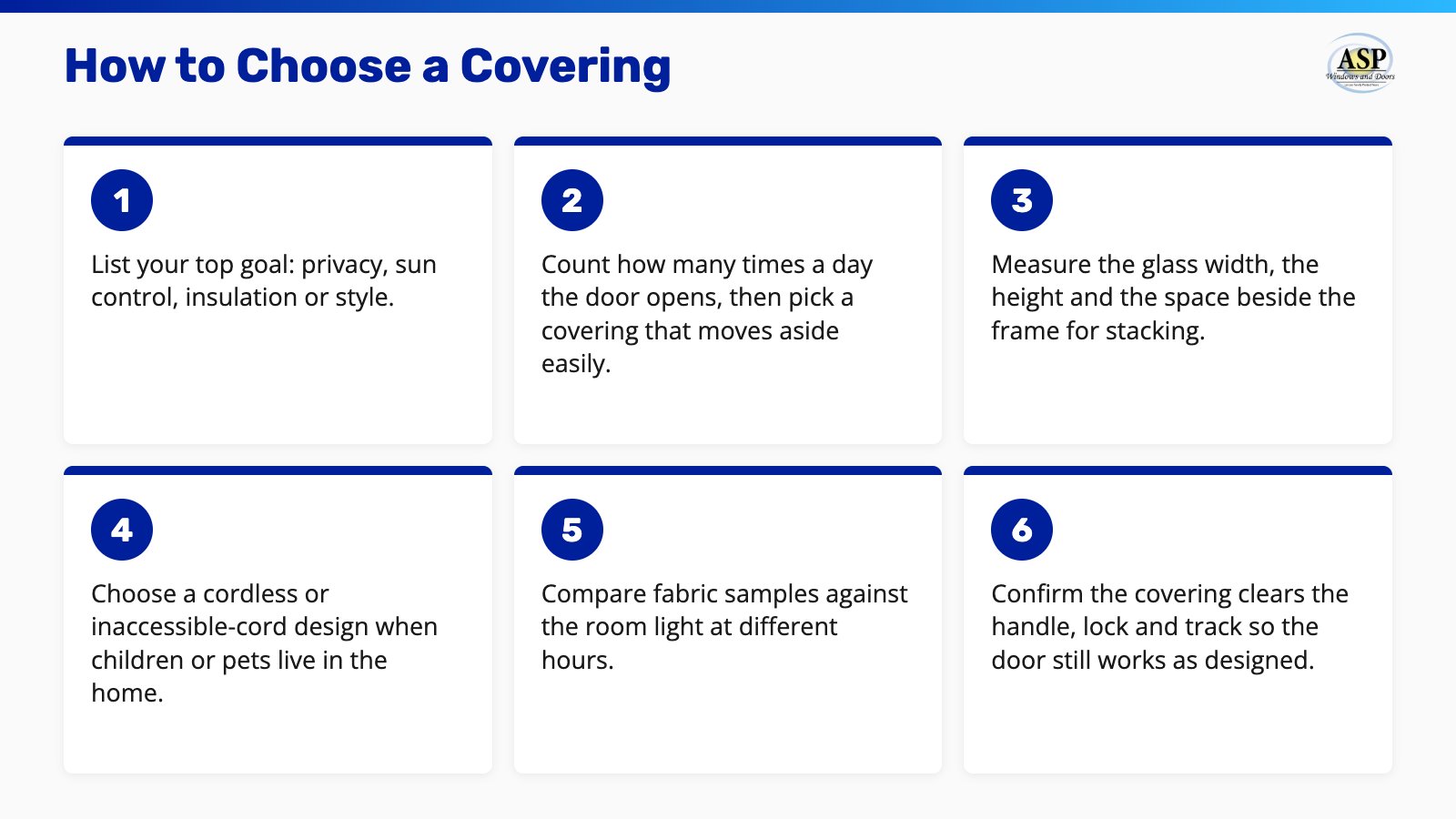
To choose a covering for a sliding glass door, rank your goals, measure the opening and match the use. Following the same order every time prevents costly mistakes. Use these steps.
- List your top goal: privacy, sun control, insulation or style.
- Count how many times a day the door opens, then pick a covering that moves aside easily.
- Measure the glass width, the height and the space beside the frame for stacking.
- Choose a cordless or inaccessible-cord design when children or pets live in the home.
- Compare fabric samples against the room light at different hours.
- Confirm the covering clears the handle, lock and track so the door still works as designed.
Samples matter because color changes with daylight. Once the covering is chosen, a few side questions usually remain, and the short answers below cover them.
What Else Should You Know About Sliding Glass Door Coverings
Sliding glass door coverings raise a few more questions about placement, style, glass treatments and trends. Each short answer below covers one of them.
What to Put Above a Sliding Glass Door
What to put above a sliding glass door is a valance, a mounted track, a curtain rod or a roller shade cassette. Mounting the hardware 4 to 6 inches above the frame makes the door look taller. A clean top line also hides the track from view.
How to Make a Sliding Glass Door Look Nicer
To make a sliding glass door look nicer, add a covering with texture, a matching color and clean top hardware. Updating the door can be as simple as swapping old vertical blinds for woven panels. Keeping the area in front of the glass clear of clutter also helps.
A few decor choices help the space look finished. Place a plant or low bench beside the glass, not in front of it. Use a rug that picks up the covering color, and keep the track clean. Our ideas for summer window decor offer more inspiration.
What Can I Put on Glass to Make It Not See Through
Frosted film, patterned film or a room-side covering makes glass not see through. Frosted film blurs the view from outside but still lets light in. Check with the door manufacturer first, because film and glass type do not always match.
One-way reflective film lets you see out by day, but it reverses at night when lights are on inside. Blinds or sheer drapery handle nighttime privacy better.
What Are Good Accessories for Sliding Doors
Good accessories for sliding doors are a track security bar, eye-level decals, a draft guard and a pet-friendly handle. A security bar sits in the bottom track and blocks the panel from opening. It adds a simple layer to a sliding door. Our guide to door security upgrades lists more.
Our post on door lock safety covers the latch itself.
A security bar is a brief add-on, not a replacement for strong glass and locks.
What Is the Newest Trend in Window Coverings
The newest trend in window coverings is motorized and smart-home controls, plus natural woven textures and neutral colors. Wide panel track blinds and sheer vertical drapery also remain popular for glass doors. Trends change, so choose a style you will still like in several years.
How ASP Windows & Doors Helps With Sliding Glass Door Coverings
ASP Windows & Doors helps homeowners choose coverings that fit their sliding glass doors through our window blinds service. We measure the opening, review the options with you and install the product. That removes the guesswork about width, stacking space and mounting height.
Coverings improve privacy and comfort, but they do not protect the glass in a storm. Homeowners who want both can pair blinds with hurricane-impact sliding doors, which meet Miami-Dade and Florida Building Code requirements. Our in-house team handles the permitting for door replacements.
Our post on sliding door advantages explains the benefits of those doors.
Samples and measurements are part of the same visit.
Browse our blind options to see what is available.
To get started, request a no-cost estimate or call (888) 782-8342.
Families across South Florida rely on ASP Windows & Doors for windows, doors and finishing touches that make a home feel complete.
Now Accepting Appointments
Proudly serving homeowners and businesses across South Florida and Southwest Florida. Book your visit and let our experts help protect and upgrade your space.


Insights & Resources
Stay informed with expert tips on impact windows, hurricane protection, and South Florida building standards.