.avif)


What Best Lubricant for Sliding Glass Doors is
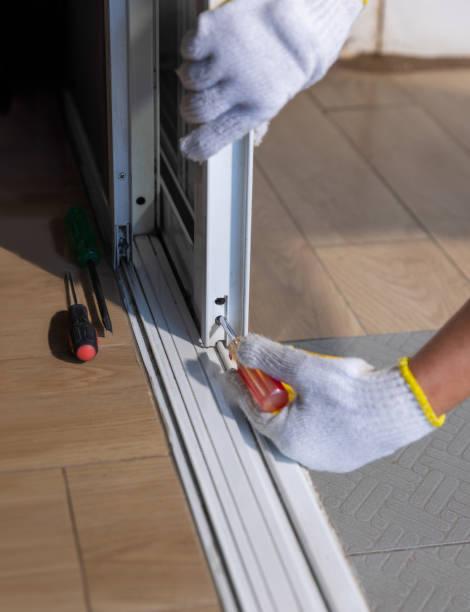

The best lubricant for sliding glass doors is a silicone spray. It leaves a thin water-resistant film, repels dirt instead of collecting it, and will not attack the rubber and vinyl parts of the door. A PTFE dry lubricant is a close second and performs better in sandy conditions. Below we cover what each type actually does, why petroleum sprays cause problems, how to apply lubricant to the rollers correctly, whether the track should be lubricated at all, and how to tell when a sticking door is a mechanical problem that no spray will solve. We install and service doors rather than sell lubricant, so no brand is recommended anywhere in this article.
Key Takeaways
- Silicone spray is the default choice, and PTFE dry lubricant is the better pick in sandy or dusty conditions.
- Petroleum sprays attract grit and can degrade rubber and vinyl components over time.
- The rollers need lubricant. The track surface usually needs cleaning instead.
- Published intervals range from every six months to once or twice a year, and actual need depends on use and exposure.
- A door that sticks after cleaning and lubrication has a mechanical problem, not a lubrication problem.
- Impact-rated panels weigh roughly 130 to 200 pounds, so roller wear happens faster than on a builder-grade slider.
- The perimeter weatherstripping on an impact door is part of a tested assembly, which is why solvent damage to it matters more than it would elsewhere.
- Nearly every performance claim in this category comes from a company selling a product, and we flag the source each time.
What Is the Best Lubricant to Put on a Sliding Glass Door?
The best lubricant to put on a sliding glass door is a silicone spray, provided the door's problem is actually friction. That caveat carries more weight than the recommendation itself, and we come back to it further down.
Friction is the condition silicone addresses well. Panda Windows & Doors reports that silicone dries quickly, resists water, suits metal, rubber, vinyl, and plastic alike, and does not attract dirt the way oil does. Gators Sliding Doors describes it as a dry lubricant that forms a thin water-resistant coating without leaving sticky residue. Both are companies in this trade, and both land in the same place.
The same place is where most professionals land, ourselves included. Silicone is forgiving, cheap, widely available, and safe on every material in a modern sliding glass doors assembly. What it cannot do is compensate for a worn roller or a damaged track.
What Lubricant to Use on Sliding Glass Doors
The lubricant to use on sliding glass doors depends on the component and the environment, and six product types show up in this category. Each behaves differently on the same door.
The same door has metal rollers, a metal track, and rubber or vinyl seals, and no single product is ideal for all three. Here is how the options compare.
Lubricant Type
How It Works
Best Use
Safe on Rubber and Vinyl
Main Drawback
Silicone spray
Leaves a thin water-resistant film
Rollers, hardware, weatherstripping
Yes
Needs reapplication a few times a year
PTFE dry lubricant
Deposits microscopic dry particles that bond to the surface
Rollers in sandy or dusty conditions
Yes
Costs more than silicone
Graphite powder
Dry carbon film between surfaces
Locks and keyways
Yes
Black powder stains light finishes
White lithium grease
Thick semi-solid coating
Enclosed metal-to-metal parts, away from open track
Check the label
Attracts dirt and grit
Wax-based lubricant
Leaves a hard waxy film
Exposed surfaces in dusty areas
Yes
Can build up in layers over time
Petroleum multi-use spray
Solvent carrier plus a light oil
Freeing a seized part, then cleaned off
No
Attracts grit and can degrade seals
Sources: lubricant type characteristics per published guidance from Panda Windows & Doors, Gators Sliding Doors, and Superior Industries. Readers should note that this category has no independent testing body, and the sources above are companies that manufacture, sell, or install related products. Product behavior varies by formulation, and label instructions supersede general guidance.
Why Silicone Is the Standard Recommendation
Silicone is the standard recommendation because it lubricates without staying tacky, which means it reduces friction without turning the track into flypaper for grit. That single property is what separates it from oil.
Oil stays wet. Silicone flashes off its carrier and leaves behind a film that feels dry to the touch, so airborne dust lands on it and blows away rather than sticking. On a door that opens onto a patio, a pool deck, or a yard, that difference decides whether the track is clean in six months or packed with a grinding paste.
Grinding paste is exactly what forms when dirt bonds to an oily film, and it does more damage to rollers than dry friction ever would. Silicone also stays flexible on rubber and vinyl instead of drying them out, which matters on sliding doors where the perimeter seal does real work against wind-driven rain.
Is PTFE Better Than Silicone?
PTFE is not clearly better than silicone, and the companies making that claim have a commercial reason to make it. This is a genuine disagreement in the category and it deserves a straight answer.
A straight answer starts with who is saying what. Superior Industries, which manufactures a PTFE aerosol, states that its dry lubricant is more slippery than silicone, graphite, or oil, and that it remains stable to 500 degrees Fahrenheit without staining painted surfaces. Gators Sliding Doors names a specific silicone product as its choice, in an article carrying affiliate links to that product. Both parties earn money from the recommendation they give.
Giving a recommendation without that stake, our read is that both work and the choice is situational. Silicone is more forgiving across mixed materials and costs less. PTFE holds up better where fine sand and grit are constant, because the dry particle film gives dirt even less to cling to. Neither one rescues a roller that has already failed, which is the part both product categories quietly leave out.
Should You Use WD-40 on a Sliding Glass Door?
You should not use WD-40 on a sliding glass door's tracks or rollers, though it has a legitimate role in freeing a seized part before you lubricate properly. The product is a water-displacing solvent with a light oil, not a long-term lubricant, and it was never designed to be one.
Designed use aside, Gators Sliding Doors lists the practical problems: petroleum sprays leave residue that traps debris in tracks, evaporate quickly enough to need frequent reapplication, and contain ingredients that may degrade rubber seals and plastic components over time. The same source notes it can be appropriate for loosening a rusted or stuck part, or for cleaning grime before applying silicone.
Applying silicone afterward is the part people skip. If you use a penetrating spray to free something, wipe the residue off completely and then lubricate with silicone or PTFE. Leaving the petroleum product in place as the lubricant is what causes the buildup problem three months later.
What Lubricants Should You Avoid?
The lubricants you should avoid on a sliding glass door are cooking oils, petroleum jelly, motor oil, and any heavy grease applied to an exposed track. All four share the same failure mode.
The failure mode is dirt capture. Panda Windows & Doors notes that household substitutes such as vegetable oil or petroleum jelly may provide temporary relief but attract dust and dirt that can damage door components. Motor oil behaves the same way and adds staining. Heavy grease works well inside a sealed bearing and poorly on an open track exposed to a Florida yard.
Exposure is the deciding factor every time. A lubricant that would be perfect inside an enclosed mechanism becomes a liability on a surface that sits open to sand, pollen, and salt air. That same logic governs how we treat every exposed component in an impact glass assembly, where hardware and seals face the outdoors continuously.
Do Sliding Glass Doors Need Lubrication?
Sliding glass doors do need lubrication, and they need it less often than most maintenance articles suggest. The rollers carry a heavy panel across a metal track thousands of times a year, and that contact benefits from a low-friction film.
A low-friction film also protects against corrosion, which matters more in coastal air than inland. What lubrication does not do is compensate for dirt. A track full of sand will bind a door regardless of how much silicone reaches the rollers, and cleaning solves more sticking complaints than lubricating does.
Cleaning first is why every credible source in this category puts it as step one. Our own guidance to homeowners is the same one on our service pages: regular cleaning with occasional lubrication of the track system is typically all a well-installed door needs.
How Do You Lubricate the Rollers on a Sliding Glass Door?
You lubricate the rollers on a sliding glass door by cleaning the track first, then delivering lubricant into the roller housing through the access opening at the bottom of the panel. Spraying the general area accomplishes very little, because the rollers sit inside a housing rather than out in the open.
The housing is reachable in six steps:
- Vacuum the track thoroughly, then wipe it with a damp cloth and let it dry completely.
- Find the roller access points, usually small holes or adjustment screw covers at the bottom corners of the panel edge.
- Fit the straw applicator to the can and direct it into the housing rather than at the track surface.
- Apply a short burst. A flood of product will run out and collect dirt without reaching anything useful.
- Slide the door open and closed several times to distribute the film across the roller bearings.
- Wipe away every trace of excess from the track, the sill, and the panel edge.
Wiping the excess also protects the weatherstripping, since a puddle of product sitting against a seal does the seal no favors. Anyone already dealing with weather sealing issues should address those before adding lubricant to the situation.
Should You Lubricate the Track?
You should generally not lubricate the track surface itself, and most sticking complaints are solved by cleaning it instead. This runs against what most articles on this topic recommend, and we think most articles on this topic are wrong about it.
Wrong, because of what a track actually is. The rollers ride on a raised rail, and the bearing surfaces that need lubricant are inside the roller assembly. Coating the rail gives the wheels something slippery to skid on rather than roll across, and it gives every piece of airborne grit a place to stick. A clean, dry rail lets a healthy roller do its job.
Its job gets harder once grit embeds in a film on the rail, because the roller then grinds that grit into the metal on every pass. Flattened rail profiles and scored rollers are common results, and both are repairs rather than maintenance. Clean the track. Lubricate the rollers.
How Often Should You Lubricate a Sliding Glass Door?
How often you should lubricate a sliding glass door works out to roughly twice a year in normal conditions, and published guidance ranges from every six months to once or twice annually. Panda Windows & Doors recommends every six months with more frequent service under heavy use. The American Sliding Door suggests at least once or twice a year.
A year is a long interval for a door that opens forty times a day onto a pool deck, and a short one for a guest room slider that opens twice a month. Usage volume, distance from salt water, and how much sand or pollen the opening sees all move the number more than the calendar does.
The calendar is still useful as a prompt. We suggest pairing it with something already on your schedule, such as pre-season storm preparation, and cleaning the track at the same time. Our common questions page covers the rest of the routine maintenance we recommend for installed systems.
What Can I Use to Make My Sliding Glass Door Slide Easier?
To make your sliding glass door slide easier, start with a vacuum and a damp cloth, then a silicone spray, and then the roller adjustment screws. Those three in that order resolve most complaints without any parts.
No parts are needed because the most common causes are cumulative rather than mechanical. Sand and grit pack into the track over years. The roller film wears off. The rollers drift out of adjustment as the building settles and the panel gradually sits at the wrong height, dragging on the sill or binding at the head.
Binding at the head is the tell that adjustment rather than lubrication is the issue. Most panels have a screw at each bottom corner that raises or lowers that side of the door, and a quarter turn is often enough. Turning them past their range, or finding the door still binds afterward, moves the problem into the next section.
When Lubricant Is Not the Fix
Lubricant is not the fix when the door still resists after the track is clean and the rollers have been serviced, because at that point the problem is mechanical. Continuing to spray a failing roller masks the symptom while the damage accelerates underneath.
Underneath a stubborn door, one of five things is usually happening. Work through them in order:
- Clean the track completely, including the corners and the drainage weep holes, then test again. This alone resolves a large share of complaints.
- Inspect the rail profile for flattening, dents, corrosion, or a section that has been crushed by something heavy.
- Check the roller adjustment screws at both bottom corners and confirm the panel sits level.
- Watch the gap along the head and the sill as the door travels. An uneven gap means the panel or the frame is out of square.
- Inspect the rollers for flat spots, seized bearings, or a wheel that slides rather than turns.
Anything found in steps two through five is a repair, and no product in a can will change that. Impact-rated sliding impact doors are worth diagnosing properly rather than nursing along, because the hardware is engineered to a specific load and a failing roller puts that load somewhere it does not belong.
Why Impact Doors Have Different Maintenance Needs
Impact doors have different maintenance needs because their panels are far heavier and their seals are part of a tested assembly. Generic advice written for a builder-grade slider does not transfer cleanly.
Transfer breaks down on weight first. A glazed sliding panel runs roughly 6.5 pounds per square foot, which puts a standard 36 by 80 inch impact panel near 130 pounds and a large 48 by 96 inch panel near 208 pounds. That load rides on the same small bearings a lighter door uses, so rollers wear faster and adjustment drifts sooner. Servicing them on schedule matters more, not less.
Mattering more applies to the seals too. On an impact doors assembly the perimeter weatherstripping is part of what was tested and approved, so a solvent that hardens or shrinks it is degrading a code-relevant component rather than just a comfort feature. Coastal exposure compounds all of it, and homes near the water in Doral see salt and sand loads that inland maintenance schedules never account for.
Can the Wrong Lubricant Void Your Warranty?
The wrong lubricant can affect warranty coverage, because most manufacturer warranties exclude damage caused by improper maintenance or unapproved products. None of the articles competing for this topic mention it, including the two written by manufacturers.
Manufacturers write these exclusions because a solvent that degrades a seal or a finish produces a failure the product itself did not cause. If a weatherstrip hardens and cracks two years after a petroleum spray was applied to it weekly, that is a maintenance outcome rather than a defect.
Defect coverage stays intact when you follow the documentation, so the safe move is to read the care instructions that came with the door before buying anything. Our product warranties spell out what is covered on the assemblies we install, and a two-minute look at that page beats a guess at the hardware store.
How to Protect the Finish and Seals
You protect the finish and seals by controlling where the product lands, which mostly means applying it deliberately rather than spraying into the opening. Overspray causes more of the problems we get called about than the lubricant choice does.
Calls about hazy glass, slippery flooring, and discolored frames trace back to the same handful of habits. Avoid them this way:
- Spray onto a cloth and wipe it on wherever the geometry allows, instead of misting the whole opening.
- Shield the glass with a rag or a piece of cardboard, since silicone film on glass is stubborn to remove and repels cleaner.
- Protect the flooring below the sill. Silicone on tile creates a genuine slip hazard.
- Check the label for solvent content before using anything near anodized aluminum or powder-coated frames.
- Wipe excess within a few minutes, before it can pool against a seal or run down the frame.
- Test on a hidden spot first if you are using an unfamiliar product on a finished surface.
Finished surfaces are also where early trouble shows up, so treat a maintenance session as an inspection. Cloudiness inside the glass points to seal failure in the insulated unit and has nothing to do with lubrication at all.
Frequently Asked Questions
Can You Use Petroleum Jelly on a Sliding Door?
You can use petroleum jelly on a sliding door and you should not, because it attracts dust and dirt that damage door components over time, according to Panda Windows & Doors. It also stays tacky indefinitely rather than drying, so the buildup begins immediately. A silicone spray costs very little and behaves far better.
Can You Use Cooking Oil on a Sliding Glass Door?
Cooking oil should not be used on a sliding glass door. It attracts grit the same way any oil does, and it also goes rancid, which produces an odor and a sticky varnish-like residue as it oxidizes. Removing that residue later is harder than the original sticking problem was.
What if the Door Still Sticks After Lubricating?
If the door still sticks after lubricating, the cause is mechanical rather than frictional. Worn rollers, a flattened or dented track, or a frame that has moved out of square all produce resistance that lubricant cannot relieve. Inspect the rollers and the rail profile, and treat continued resistance as a signal to stop spraying and start diagnosing.
Can Silicone Spray Damage Glass?
Silicone spray does not damage glass, though it leaves a film that is difficult to remove and that resists ordinary glass cleaner. Overspray onto the pane is a cosmetic nuisance rather than a hazard. Shielding the glass during application avoids the problem entirely, and isopropyl alcohol handles the film if it happens.
Is Graphite Good for Sliding Door Tracks?
Graphite is good for locks and keyways rather than for sliding door tracks. It works as a dry lubricant and resists dirt, but the fine black powder marks light-colored frames, sills, and flooring on contact. Silicone or PTFE deliver similar dry-film performance on a door without the staining risk.
Should You Lubricate the Lock on a Sliding Door?
You should lubricate the lock on a sliding door, and a dry lubricant is the right choice for it. Graphite or a PTFE product suits the internal mechanism, since oil inside a lock body collects dust and eventually gums up the pins. Apply sparingly and work the mechanism several times to distribute it.
The Takeaway
Silicone spray is the right answer for most sliding glass doors, PTFE is the better pick where sand and grit are constant, and petroleum sprays belong nowhere near a track or a roller except as a one-time step for freeing something seized. Clean the track, lubricate the rollers through the access opening, wipe the excess, and repeat about twice a year depending on how hard the door works.
The more useful point is the one the lubricant sellers leave out. A door that still resists after a proper cleaning and a proper application has a mechanical problem, and continuing to spray it only hides the wear while it gets worse. That matters more on an impact-rated panel, where 130 to 200 pounds rides on the hardware and the perimeter seal is part of a tested assembly rather than a comfort detail.
Our team at ASP Windows & Doors installs and services these systems, and we do not sell lubricant, which is why no brand appears anywhere above.
If your door has reached the point where a can of spray is not solving it, that is worth a look from someone who can tell a worn roller from a bent rail. The Doral showroom keeps sectioned hardware on the floor if you would rather see how a roller assembly actually comes apart. Request a free estimate and we will take it from there.
Now Accepting Appointments
Proudly serving homeowners and businesses across South Florida and Southwest Florida. Book your visit and let our experts help protect and upgrade your space.
.avif)
.avif)
.avif)
%201.avif)
Insights & Resources
Stay informed with expert tips on impact windows, hurricane protection, and South Florida building standards.


%201.webp)
%201%20(1).webp)

%201.svg)
%201%20(1)%20(1).webp)
.png%20(1).webp)
.png.webp)
.avif)
.avif)


.avif)


.png)
.png)